
Introduction
Personal care means providing care that is related to the patient’s body, appearance, hygiene, and movement.
Tasks related to personal care include:
- Bathing
- Teeth and mouth care
- Dressing/grooming
- Toileting
- Eating
- Ambulation
- Transferring
- Care of the patient’s environment
- Assisting with self-administration of medication
People may require personal care for a number of reasons. Assistance with personal care may be temporary while a person is recovering from an injury or illness or may be permanent, and is required for the remainder of their lives.
Types of patients who may need personal care include:
- Patients who are recovering from an illness or accident
- Patients with a long term chronic condition (e.g. heart failure, diabetes, HIV/AIDS)
- Frail patients or those of advanced age
- Patients who are permanently disabled
- The dying patient
- Infants whose caretakers need assistance caring for them
Providing personal care is a priority for the Home Health Aide/Personal Care Aide. It is the most important task they do. Personal care provision demonstrates to the patient concern about their physical health and general well-being.
This module will explore the importance of providing personal care and provide instruction with performing tasks related to personal care. The importance of infection control and how Home Health Aides/Personal Care Aides can work to break the chain of infection in order to keep patients healthy is discussed. Bathing, teeth/mouth care, dressing/grooming, toileting, and eating are topics discussed with explanation on how Home Health Aides/Personal Care Aides can provide assistance with these types of personal care. Transferring patients to and from various positions, and assisting with ambulation are detailed. Care of the infant with regard to properly holding, feeding, and bathing is discussed. Finally, for Home Health Aides who will assist with the self-administration of medication, the importance of the five rights of medication self-administration: right patient, right medication, right dose, right route, and right time are reviewed
Introduction to Infection Control
Providing personal care begins with the Home Health Aide/Personal Care Aide and their ability to maintain proper infection control. Handwashing is the number one way to prevent the spread of infectious agents. An infectious agent is anything that can cause disease, such as bacteria, virus, or parasites. It is the easiest and most effective way for a Home Health Aide/Personal Care Aide to stop the chain of infection.
Chain of Infection
The chain of infection is how infection is transmitted (passed). The chain of infection consists of five parts: reservoir, portal of exit, mode of transmission, portal of entry, and susceptible host.
Reservoir:
A reservoir is the same thing as a host. Reservoirs include humans, animals, and the environment, such as water or soil. This is the person, animal, or place where the infectious agent lives and grows.
Portal of exit:
This is how the infectious agent leaves its host. Portals of exit can include the respiratory system, urine, feces, and even the skin. For example, if a person has influenza (the flu), they can transmit the virus to another person when they sneeze. If a person has hepatitis B or HIV, they can transmit the virus through their blood or body secretions.
Mode of transmission:
This is how an infectious agent is transmitted (or given) to a person. There are several modes of transmission: direct contact, droplets, airborne, vehicles, and vectors.
Direct Transmission: Infectious agents are transmitted either through direct contact with a reservoir (host) or by droplet transmission.
- Direct Contact: Transmission this way occurs through direct skin to skin contact, sexual intercourse, and exchange of body fluids such as while kissing. Mononucleosis, Hepatitis B, and HIV are spread via direct contact.
- Droplets: Transmission this way occurs when droplets from sneezing, coughing, or talking are spread a few feet onto another person. Pertussis and meningococcal infections are spread via droplets.
Indirect Transmission:
- Airborne: Transmission this way occurs when droplets remain suspended in air and eventually contaminate a susceptible host. Measles is an example of an infection that is spread by airborne transmission.
- Vehicles: Transmission by vehicles occurs through blood, water, food, and fomites (objects such as surgical instruments, used tissues, and dirty bedding). Hepatitis A is transmitted through a vehicle as it is carried through food or water that has been contaminated. Botulism is spread via a vehicle as the bacteria is found in contaminated canned food.
- Vectors: Transmission via vectors occurs through ticks, mosquitoes, and fleas. Malaria is transmitted through mosquitoes (a vector). Lyme’s Disease is transmitted through ticks (a vector).
Portal of Entry:
This is how the infectious agent enters the host or person. The portal of entry is often the same as the portal of exit. For example, influenza exits an infected person’s respiratory tract and enters another person’s respiratory tract.
Susceptible Host:
The susceptible host is the person or animal who contracts the infectious disease.The very young and the elderly are most at risk for contracting an infection. The immune system is not fully developed in a young child. As we age, our immune system is no longer as effective as it was when we are young. People who are already sick or immunocompromised (who have an immune system that is unable to fight infection) are at high risk for becoming a susceptible host.
Home Health Aides/Personal Care Aides have an important role in breaking the chain of infection. By properly washing hands, wearing gloves when coming into contact with body fluids and blood, and properly cleaning and sanitizing equipment and the home, HHAs/PCAs can help stop the chain of infection. Other ways that HHAs/PCAs can help break the chain of infection include teaching patients to sneeze or cough into a tissue and then washing their hands. Teaching patients to practice proper hand hygiene before meals, after using the bathroom, and anytime hands become soiled is another important way HHAs/PCAs can help stop the chain of infection.
HHAs/PCAs should also teach patients to place used sharps from needles in designated sharps containers. Used needles should never be disposed of in the garbage or left out. This puts others at risk for contracting an infectious disease. Disposal of sharps containers will vary depending on where the HHA/PCA lives. This is an important issue that should be discussed with a supervisor.
Handwashing is the number one way to prevent the spread of infection. Hands should be washed when they are visibly dirty or soiled with blood, body fluids, and secretions. Hands should be washed before and after eating and using the restroom. Hands should be washed when arriving at and before leaving the patient’s home. Wash your hands before putting on gloves and after removing them. Wash your hands before and after all patient contact, including contact with the patient’s belongings.
When Home Health Aides/Personal Care Aides care for patients, they should always practice proper hand hygiene and use personal protective equipment (PPE). This includes the use of gloves. Gloves should be worn anytime the HHA/PCA will come into contact with blood or body fluids, such as urine, feces, or vomit. Gloves should always be changed when they are visibly soiled or ripped.
Procedure – Handwashing
- Ensure all materials needed are on hand at the sink. This includes soap, paper towels and/or a cotton towel if paper towels are unavailable. Be sure the soap is within arm’s length so you do not have to touch the sink to reach it.
- Roll up your sleeves and remove your watch and jewelry. These items may hold bacteria.
- Stand away from the sink. Do not let your hands, body, or uniform touch the sink at any time, as it is contaminated.
- Wet your hands and wrists thoroughly under warm, running water.
- Apply soap to your hands.
- Keep your hands and forearms lower than your elbows, with your fingertips down. Your hands are dirtier than your forearms. If you allow water to run from your hands to arms, you will contaminate those areas.
- Rub your hands together and lather all surfaces of your wrists, fingers, and hands.
- Clean your nail beds by rubbing them in the palm of your other hand. Pay attention to knuckles and the sides of your fingers. Ensure all your fingers are washed, including thumbs and little fingers, which can easily be missed. Interlace your fingers and use a rubbing motion to ensure all surfaces of your hands and fingers are washed.
- Use friction by rubbing your hand surfaces together for at least 20 seconds, which is the appropriate length of time to cleanse hands according to the CDC current guidelines. Humming or singing the “Happy Birthday” song twice from beginning to end is one way you can time 20 seconds.
- Rinse all surfaces of your forearms, wrists, hands, and fingers, ensuring that you keep your hands below your elbows, and allow the water to rinse off, starting from forearms to wrists down to fingers. This prevents dirty water from your hands from running onto your forearms and contaminating those surfaces.
- Be sure to not touch the sink while washing your hands.
- Use a clean, dry paper towel or clean cotton towel to dry your hands. Dry your hands starting with your fingers, and move up to your wrists, and then forearms.
- Dispose of the paper towel in a garbage can without touching the garbage can or other surfaces.
- With a clean and dry paper towel, turn off the faucet. Faucets are dirty, and you risk contaminating your hands if you use your hands and not a paper towel to turn off the faucet. Use a clean and dry paper towel, rather than the wet one used to dry your hands. This prevents bacteria and other pathogens from transferring onto the paper towel and then your hands.
- Dispose of the paper towel.
- Apply cream or lotion to your hands as needed to prevent your skin from cracking or drying. Cracked or dried skin leads to skin breakdown. Skin breakdown leads to open areas for bacteria and other pathogens to easily enter your skin.
Use of Alcohol-Based Hand Sanitizer
In the case when no running water is unavailable, you may use an alcohol-based cleanser that contains at least 60% alcohol.
- Apply a generous amount of alcohol-based sanitizer to the palm of one hand.
- Rub your hands together, covering all surfaces of your hands and fingers. Use friction as you would when washing your hands with soap and water by rubbing hand surfaces together.
- Interlace your fingers and rub hands together to ensure all surfaces of your hands have been covered with the cleanser.
- Rub the palm of one hand over the back of the other.
- Rub the thumb of one hand in the palm of the other. Do the same with your other thumb.
- Rub the fingers of one hand into the palm of the other to clean nail beds. Repeat to clean the nail beds of your other hand.
- Rub hands together until the product has completely dried.
- Remember, hand sanitizers are not as effective at removing germs as washing your hands. You should use soap and water when hands are visibly soiled or dirty.
Procedure – Donning & Removing Gloves
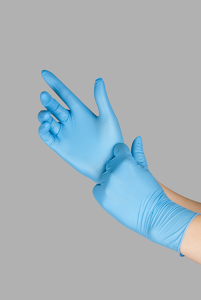
Gloves should be used any time you will come into contact with blood or body fluids including vomitus, urine, feces, or saliva. Gloves should also be worn when providing a bath, mouth care, when shaving a patient, and when disposing of soiled linens, dressings, and bed pads. Gloves should be worn anytime you have cuts or open areas on your hands in which bacteria could enter your skin. If allergic to latex Home Health Aides/Personal Care Aides should inform their employer so that appropriate latex free gloves can be provided to them. Gloves are only to be used once. Never wash or reuse them. Any time gloves become soiled, torn, or wet, replace them with new ones. Remember to perform hand hygiene prior to and after removing gloves.
Donning (applying) gloves:
- Wash and dry your hands as outlined in the hand washing procedure.
- If right-handed, pick up one glove with your right hand. Position glove so that the thumb side of the glove aligns with your thumb on your left hand. Slide glove onto your left hand.
- If left-handed, pick up glove with your left hand and slide onto your right hand. Be sure not to touch anything that may be contaminated.
- Keep hands above your waist while donning gloves to ensure you do not touch contaminated surfaces.
- With your gloved hand, take the second glove and slide your other hand into it.
- Be sure to replace any gloves that appear soiled, ripped, or torn.
Removing gloves:
- When removing gloves, touch only the outside of the glove. Do not touch your wrist or skin with contaminated gloves.
- Grasp the outer surface of the glove below your thumb. Slide your thumb under the cuff of one glove near the base of your palm (do not touch the skin under your glove). Grasp the glove and peel the glove off, so that it is inside out. Keep the discarded glove in your gloved hand.
- With your ungloved hand, put two fingers underneath the cuff of the remaining glove, taking care not to touch the outside of the glove. Peel glove off your hand in the direction towards your fingers. As you remove the glove, turn it inside out into the other discarded glove. This keeps the soiled gloves together with their dirty surfaces folded inside, rather than on the outside. This prevents risking contaminating your hands with the soiled gloves.
- Discard gloves and wash your hands as outlined in the hand washing procedure.